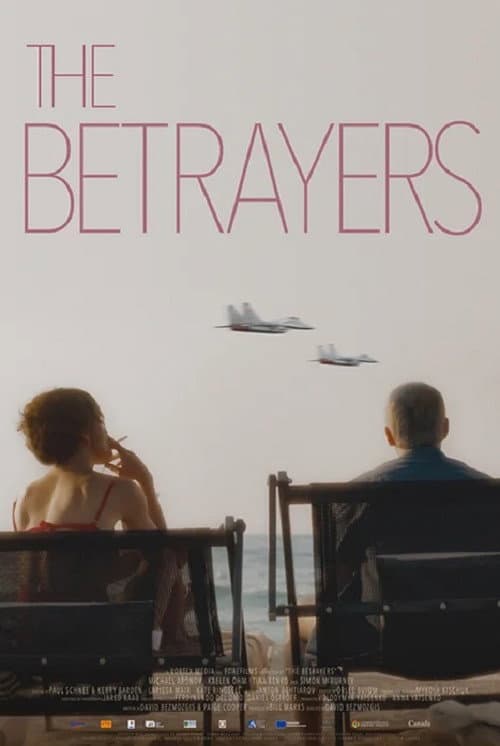
David Bezmozgis had a problem worth solving. His new film, The Betrayers, needed to hold two kinds of treachery in the same frame - the political kind that reshapes borders and lives, and the intimate kind that quietly dismantles a person from within. The drama, which opened in theaters on September 12, plants a former Israeli politician and onetime Soviet dissident at a Crimean resort, where he stumbles upon the man who once betrayed him. What follows is less a revenge story than a slow, painful reckoning with memory, justice, and whether forgiveness is even a coherent idea when the wound never closed.
The film runs 90 minutes and stars Michael Aronov, Simon McBurney, Kaelen Ohm, and Viktorija Portnova. It marks another step in Bezmozgis's move from acclaimed fiction writer to filmmaker, and it arrives with an unusual set of pressures: a historical backdrop that remains politically charged, a setting - Crimea - that carries its own contested weight, and a central conflict that refuses to resolve into easy catharsis.
Two Betrayals, One Room
Speaking about the project, Bezmozgis said the emotional engine of the film was never the geopolitical backdrop alone. "The political betrayal and the personal betrayal are not parallel tracks," he said. "They are the same wound seen from different distances. Up close, it is a man who trusted someone. From far away, it is a country that trusted someone. I was interested in whether you can heal one without the other."
That idea shaped the film's structure. Aronov plays the former politician whose past as a Soviet dissident still shadows his present. McBurney appears as the figure he finds at the Crimean resort - the betrayer. The confrontation unfolds largely through conversation and silence rather than action set pieces, a choice Bezmozgis said was deliberate. "A thriller can be two people in chairs if the stakes are real," he said. "The question is whether the audience feels the cost of every sentence."
The director also acknowledged the difficulty of filming a story rooted in a region whose political status is disputed. He said the production approached Crimea as a landscape of memory rather than a statement of position. "The resort is not a geopolitical argument," he said. "It is a place where someone went to rest and instead found his past waiting for him. That is the geography I cared about."
A Cast Built for Ambiguity
Bezmozgis credited his cast with carrying the film's moral ambiguity. Aronov, he said, brought a "controlled exhaustion" to a man who has spent decades performing composure. McBurney, a veteran of stage and screen known for playing men whose charm conceals something colder, was cast against the instinct to make the betrayer monstrous. "Simon understands that the most dangerous person in the room is often the most reasonable-sounding one," Bezmozgis said. "He never plays the villain. He plays a man with a rationale."
Kaelen Ohm and Viktorija Portnova round out the ensemble, and Bezmozgis said their presence keeps the film from collapsing into a two-hander about men and history. "The women in this story are not observers," he said. "They are the ones who have to live with the consequences of a confrontation they did not choose."
The film's English-language production places it firmly within Hollywood's independent drama space, though its concerns reach well beyond a single market. Bezmozgis said he was drawn to the story because it refused to let anyone off the hook - not the betrayer, not the betrayed, and not the audience. "Everyone wants the moment where the truth lands and the music swells," he said. "I wanted the moment after that, when nobody knows what to do next."
A Quiet Entry in a Crowded Season
The Betrayers arrives without the machinery of a franchise or a built-in following. Its 90-minute runtime is lean by contemporary standards, and its subject matter - dissident politics, exile, the long tail of personal injury - is not the stuff of easy marketing. Early audience metrics on TMDb show a 0/10 rating, a figure that at this stage reflects a lack of sufficient voting data rather than any verdict on the film itself.
Bezmozgis, for his part, seems comfortable with the film's smaller footprint. He described the project as an attempt to trust the audience with discomfort rather than resolve. "The title is plural for a reason," he said. "There is more than one betrayer in this story, and more than one person who feels betrayed. That is the only honest way to tell it."
Whether audiences will sit with that honesty remains an open question. But in a release calendar dominated by spectacle, The Betrayers is betting that two people in a room, and a past that will not stay buried, can still be enough.
Source: Hollywood Reporter