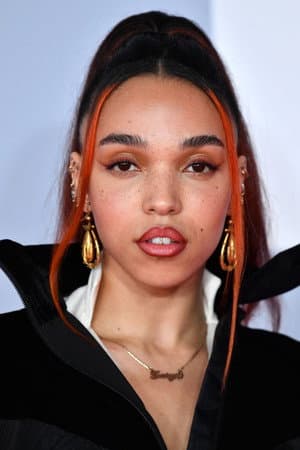
The first image of FKA Twigs as Josephine Baker has arrived, and it lands with the kind of jolt that a Baker performance once delivered on a Paris stage. The British singer, dancer, and actress is starring as the legendary expatriate entertainer in Maïmouna Doucouré's forthcoming biopic, and a newly unveiled still offers an early glimpse of her transformation into one of the twentieth century's most magnetic figures. The photo has circulated widely since its release, reigniting interest in a project that has been quietly assembling momentum.
The image presents Twigs in Baker's orbit rather than as a static imitation. Details of costume and styling evoke the era in which Baker conquered European audiences, while Twigs's own celebrated background as a dancer lends the portrait a physical credibility that a purely dramatic casting might lack. That combination - a performer known for rigorous movement work stepping into the role of a woman whose fame rested on rhythm, stagecraft, and sheer presence - has been central to the early buzz around the film.
For Doucouré, the project follows her widely discussed feature debut, "Cuties," which drew international attention and a fiercely polarized reception when it arrived on Netflix. That film announced a filmmaker preoccupied with the lives of young girls and the pressures placed upon them, themes that sit naturally alongside a Baker story. Baker's journey from poverty in St. Louis to global stardom in France, and her later work as a spy for the French Resistance and a civil rights advocate, gives a director with Doucouré's interests an unusually rich canvas.
Baker's biography is, by any measure, operatic. Born in Missouri at the turn of the twentieth century, she left the United States as a young woman and found in Paris an audience willing to celebrate a Black performer in ways her home country would not. Her 1925 appearance in the Revue Nègre made her a sensation, and the banana-skirt image that followed became one of the defining - and most contested - visual artifacts of the Jazz Age. She became a French citizen, sang for troops during the Second World War, smuggled documents for the Resistance, and later stood alongside Martin Luther King Jr. at the March on Washington. She also built a family of adopted children from around the world, whom she housed at a château in the Dordogne.
That breadth is both the promise and the challenge of any Baker film. A single feature must decide where to concentrate its gaze: the ascent, the wartime years, the civil rights turn, or the private life. Doucouré has not publicly detailed her approach, and the first-look still offers atmosphere rather than narrative specifics. What the image does establish is a production committed to visual seriousness - the lighting, framing, and period texture suggest a filmmaker treating Baker's world as something to be reconstructed with care rather than skimmed.
Twigs's casting itself carries a certain logic. She has spent more than a decade building a reputation as one of pop's most exacting physical performers, with a visual language drawn from contemporary dance, experimental film, and fashion. Her acting credits remain selective, which makes a leading role of this scale a notable step. The overlap between her public persona - precise, enigmatic, fiercely self-directed - and Baker's own carefully constructed image is difficult to miss, and the early photograph leans into it.
The supporting cast, production timeline, and release plans have not been confirmed in verified detail, and the project's distributors have yet to lay out a campaign. For now, the conversation rests on a single image and the reputations of the two women at its center. That is often enough in an industry that runs on anticipation, and the response to the still suggests the film has already cleared the first hurdle: people want to see more.
What remains to be seen is whether the finished work can hold Baker's contradictions - the glamour and the activism, the adopted homeland and the American roots, the performed exoticism and the私人 determination beneath it - without flattening them into a conventional rise-and-fall narrative. Doucouré has shown an appetite for uncomfortable subjects, and Twigs has shown an appetite for control over her own image. A Baker biopic made by those two instincts could be something considerably stranger and more interesting than the standard musical biography.
For now, Hollywood is watching. A first look is a promise, not a performance, but this one has landed with unusual force - and the woman at its center appears ready to answer it.
Source: Hollywood Reporter