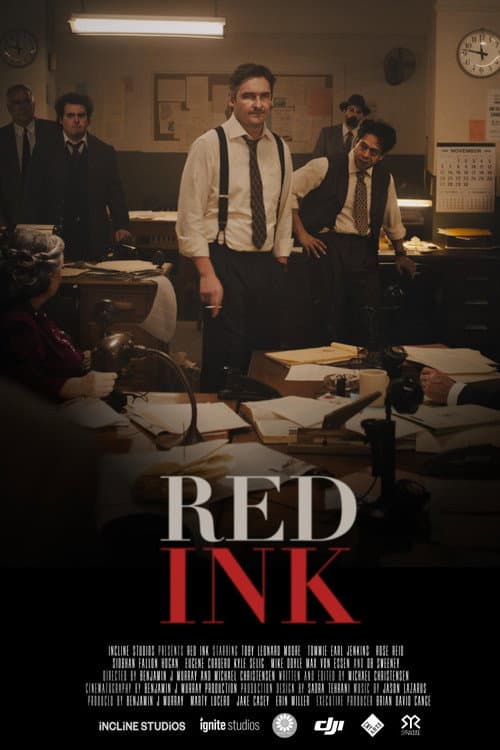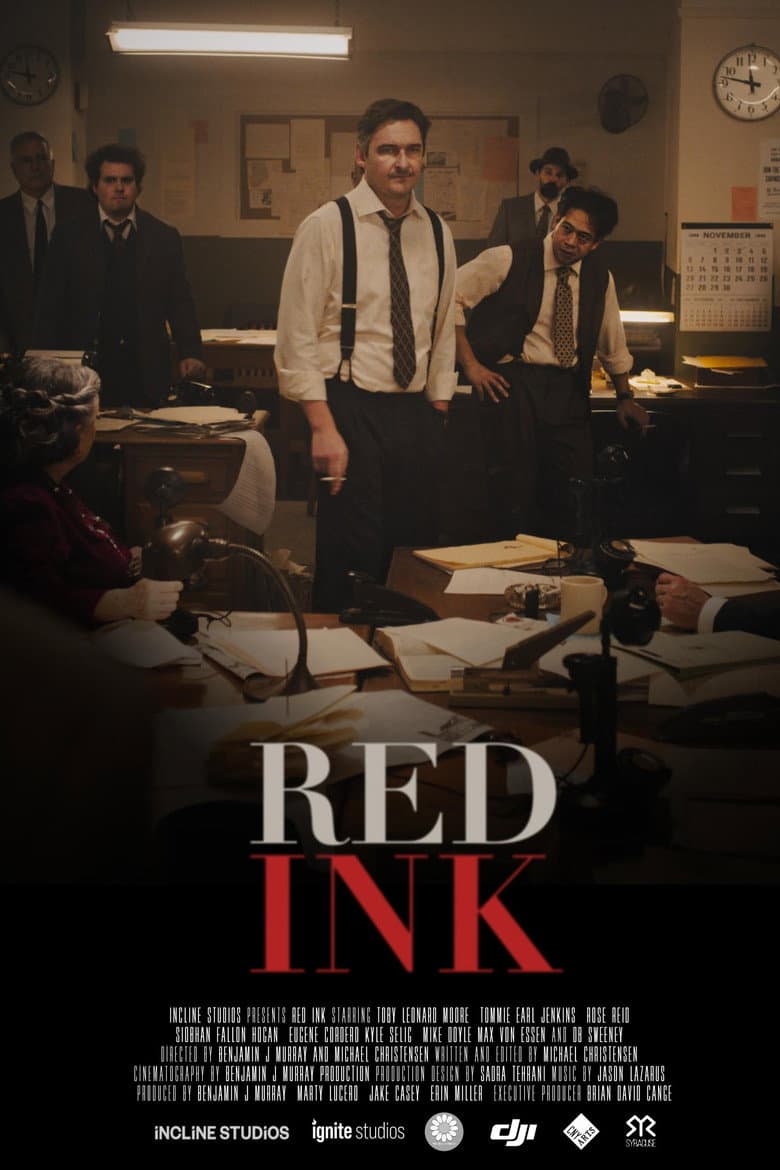
Benjamin J. Murray's "Red Ink" arrived in theaters on November 7, and it is already being talked about less for its genre trappings than for the audacity of its construction. The film, a drama-thriller set in post-World War II New York, unfolds in a single unbroken take, a formal gamble that turns a story about propaganda and institutional power into a queasy, real-time experience of watching those forces operate on the people inside them. The premise alone is unusual: a 1940s newsroom thriller shadowed by the threat of a mysterious global virus, with vampires woven into the machinery. That Murray released it as a continuous shot rather than a conventionally edited feature has made it the season's most dissected technical achievement.
The setting is a media landscape still reeling from war, where information is a weapon and the people who handle it are compromised in ways they may not fully see. "Red Ink" uses that environment to interrogate how propaganda works, how institutions protect themselves, and who gets exploited when the machinery needs to keep running. The film's genre label sells it short: it is a drama and a thriller in equal measure, and its horror-adjacent elements serve a thematic purpose rather than a commercial one. The looming global virus functions as a pressure valve, a shared dread that makes the newsroom's internal compromises feel urgent and unavoidable.
A Cast Built for Ensemble Pressure
Toby Leonard Moore leads as Bob Hoover, and the surrounding ensemble reads like a deliberate choice to favor character actors over marquee names. Siobhan Fallon Hogan, Tommie Earl Jenkins, Eugene Cordero, Rose Reid, Kyle Selig, and D. B. Sweeney round out the cast, with Sweeney playing Walter Nash. Mike Doyle appears as Senator Conrad, a role that places political authority directly inside the film's crosshairs. For a single-take feature, that depth matters: with no cuts to release tension, every performer has to sustain the scene's pressure without the safety net of an edit. Murray has assembled a group capable of that endurance, and the casting suggests he wanted the audience to feel the weight of ordinary people navigating extraordinary systems.
The film's original language is English, and it is a Hollywood production in the fullest sense, made at a scale that allows a period newsroom to be rebuilt as a working, continuous environment. Practically, a single-take feature demands that sets, lighting, and blocking be engineered around movement rather than around coverage. Whether "Red Ink" achieves this through digital stitching or a genuinely seamless physical run is the kind of question that will occupy viewers and industry observers alike. What is clear is that the release presents itself as a cinematic event built on craft rather than familiarity.
The Single-Take Gamble
Single-take films have a long history, but they remain rare for a reason. They require ensembles to hit marks with precision, crews to work invisibly, and directors to choreograph action without the fallback of assembling a performance in the edit. The result can feel immersive and immediate, or it can feel like a stunt that overwhelms the story. "Red Ink" has landed in a marketplace crowded with sequels and known properties, which makes its formal ambition a differentiator and a risk. With a runtime unlisted, audiences are walking into an experience whose length and pacing remain part of the discovery.
There is also the matter of measurement. On TMDb, "Red Ink" currently shows a rating of 0 out of 10, a figure that reflects an absence of aggregated audience scores rather than a verdict. Early reception will determine whether the film's construction is read as justification for its difficulty or as difficulty for its own sake. For a movie this dependent on sustained attention, word of mouth will carry unusual weight.
A Newsroom Story for a Post-Truth Moment
"Red Ink" opens at a moment when questions about media credibility and institutional accountability are as live as they have ever been. Placing those questions in a 1940s newsroom gives the film distance, but the resonance is intentional: propaganda does not require a period setting to feel familiar. The vampire elements and the mysterious virus push the story into genre territory, yet Murray's stated interests appear to be structural. By refusing to cut, he forces viewers to sit with decisions as they are made, without the relief of a transition. That is a thesis as much as a technique.
Whether "Red Ink" becomes a reference point for filmmakers or a cautionary tale about ambition will depend on how audiences respond to its demands. What is certain is that Murray has made a film that cannot be mistaken for anything else in current release, and in a landscape of familiar options, that alone is a kind of statement.
Source: Hollywood Reporter