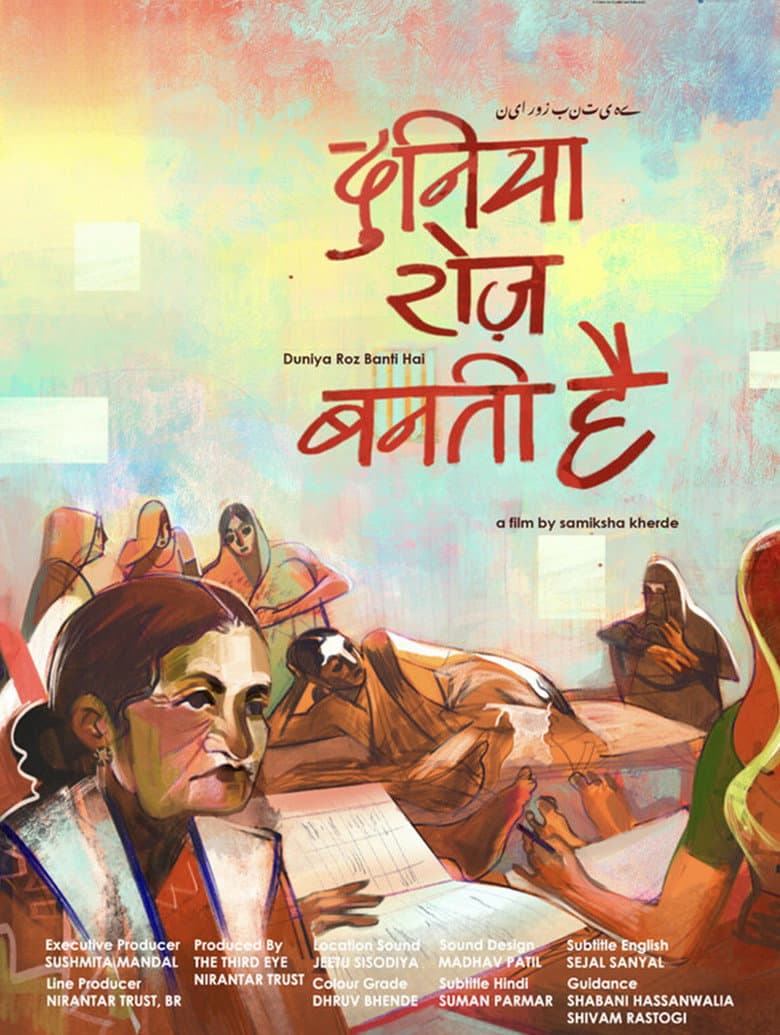
There is a particular kind of silence that fills a room when a woman has just finished recounting the worst thing that ever happened to her - and then the women around her lean in. That silence, and what follows it, sits at the heart of Samiksha Kherde's short documentary "A Women's Court," a film that resists easy conclusions as stubbornly as the communities it observes.
Release Date & Where to Watch
"A Women's Court" arrives today, October 25, 2026, timed neatly to the conversation around access to justice that keeps resurfacing in awards-season documentaries. The film runs just 18 minutes, which means it slots comfortably into a festival shorts block or a streaming documentary anthology - the kind of runtime that programmers love and that audiences, conditioned by a firehose of long-form content, increasingly appreciate. Distribution specifics have not been announced, but a documentary of this scale typically begins its life on the festival circuit before landing with a boutique streamer or public broadcaster. Keep an eye on the usual documentary platforms; a title this intimate rarely gets a wide theatrical rollout, and it doesn't need one.
Cast & Crew
The film is directed by Samiksha Kherde, an emerging voice whose interest here lies in process rather than pronouncement. The cast is listed as unknown, and that is entirely appropriate: the women of the Nari Adalats are not performing for the camera, and the film does not treat them as subjects to be packaged. There are no celebrity narrators, no orchestral cues telling you how to feel. This is observational documentary in the truest sense - a camera planted in a room, waiting.
Story & What to Expect
The Nari Adalats of rural Bihar are informal courts run by women, for women. They take up the disputes that formal legal systems either mishandle or ignore: domestic cruelty, property fights, abandonment, violence. The documentary follows the women who gather in these spaces. Many of them first arrived with disputes of their own. Now they return - to listen, to question, to mediate. That loop, from petitioner to panelist, is the film's quiet engine.
What Kherde captures is not a triumph narrative. The Adalats handle sometimes brutal cases, and the film stays with the difficulty rather than rushing past it. Women sit. Women listen. Women ask the questions that police reports and courtrooms rarely bother to ask. And what emerges from all this sitting and listening is not a fixed idea of justice but something shaped slowly, collectively, and without clear closure. If you are expecting a tidy arc in which wrongs are righted and credits roll, prepare for something more honest and more unsettling. The 18-minute runtime is a discipline here, not a limitation - Kherde trusts the material to speak without editorializing, and the result is a film that feels less like an argument than an invitation to sit in the room yourself.
Why It's Worth Watching
Documentaries about justice often make the mistake of treating institutions as characters and outcomes as plot. "A Women's Court" does neither. Its subject is the shape of collective deliberation itself - the way a group of women who have each been failed by something larger than themselves build, case by case, a way of being accountable to one another. That is rare on screen. In an era when documentaries increasingly shout, this one lowers its voice.
It is also worth watching for what it represents industrially. Kherde is a director to track, and an 18-minute film is the calling card of someone who knows exactly what she wants to say. The film's refusal to resolve - its comfort with "without clear closure" - is a stance. It argues that justice in these rooms is a practice, not a verdict, and that the practice is ongoing. You leave the film not with answers but with the image of women leaning in. For anyone exhausted by documentaries that explain their own significance, that image will linger longer than any voiceover could.
"A Women's Court" is small, precise, and unwilling to flatter its audience. In a crowded release calendar, those qualities are worth clearing 18 minutes for.