The most striking thing about Latif is how ordinary he looks. A trim beard, a quiet voice, a hand that reaches for his prayer beads before it reaches for anything else. He is also, as “Your Mother Your Mother Your Mother” establishes early and without flinching, very good at killing people. That tension - between the man who kneels toward Mecca and the man who leaves bodies in Houston parking lots - is the engine of Bassam Tariq’s new feature, which opened on September 25 to a 7.6 rating on TMDb and a growing reputation as one of the fall’s most quietly devastating genre pictures.
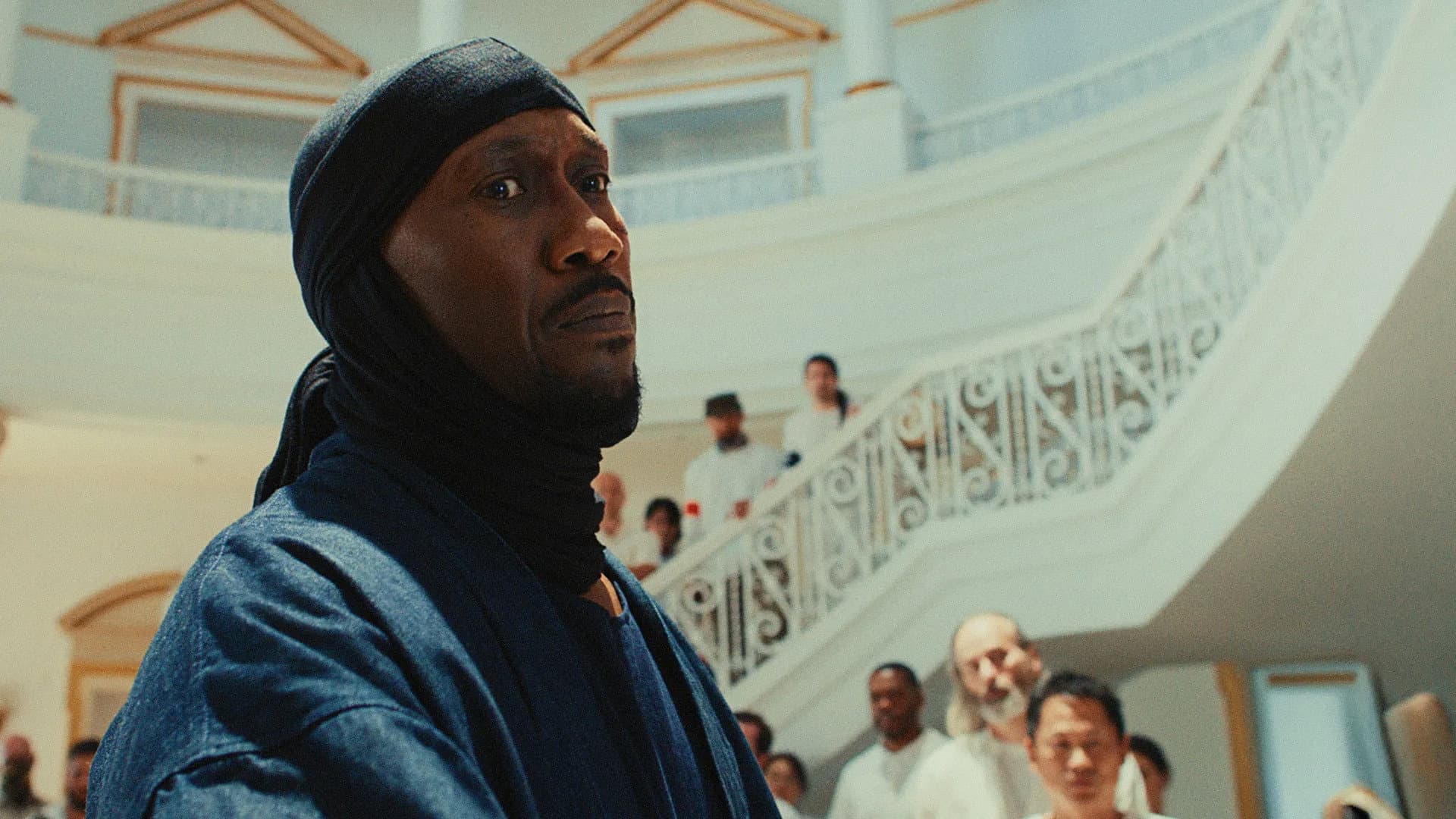
Mahershala Ali plays Latif, and it is a performance built on restraint. The film asks him to carry a prayer book in one pocket and a pistol in the other, and Ali never lets one hand know what the other is doing. Tariq, working from a script that treats faith as a living argument rather than a plot device, spends the first act letting us live inside Latif’s routine: the predawn prayer, the packed lunch, the careful arithmetic of leading a double life. By the time his wife dies, the film has earned the right to detonate that routine, and the explosion is not a car chase but something worse - a man realizing that everything he built to protect his children may have been the thing endangering them.
The plot, on paper, is a Houston odyssey. Latif moves across the city with his kids in tow, trying to keep them alive while various forces close in. But Tariq shoots Houston less as a map than as a moral landscape. The freeways blur into each other; the megachurch parking lots look as vast and empty as mosque courtyards at dawn. It is a city where everyone is selling something - salvation, loyalty, silence - and Latif no longer knows which currency he has been trading in.
He is not alone, and the supporting cast is where the film sharpens its teeth. John Cho’s Pastor Kwan is a study in gentle persistence, a man of a different faith who nonetheless becomes Latif’s unlikeliest mirror. Giancarlo Esposito as Abdul Malik brings the calm menace he has perfected, but shades it with something like paternal disappointment. Laith Nakli’s Mike Mahmoudi supplies the film’s driest humor, and Abubakr Ali, as Hatty, gives a young-performer turn that feels lived-in rather than precocious. Adia as Fatiha and Jahleel Kamara as Qadir carry much of the film’s emotional weight as Latif’s children, kids old enough to understand that their father’s silences mean something and young enough to be terrified by it. Tiffany Boone’s Fugazi is a late-film jolt - a character whose name alone signals the film’s interest in the counterfeit versions of ourselves we construct.
Tariq, whose previous work established him as a filmmaker fascinated by the spaces between belief and belonging, directs with a steady hand. The action, when it arrives, is spare and ugly, not balletic. A shootout in a warehouse is over in ninety seconds and leaves the camera lingering on what remains. Cinematography duties make the prayer scenes glow and the violence look fluorescent, as if the two worlds operated on different color temperatures. The film’s dialogue - English throughout, with all lines delivered so we understand every word - returns often to the phrase of the title, a mocking echo that Latif hears from enemies and, worse, from his own memory. It is the sound of a sacred idea being turned into a taunt.
At 112 minutes, the film moves with purpose but refuses to rush its grief. Some viewers will wish for more connective tissue between Latif’s past and present; others will appreciate Tariq’s trust that we can fill the gaps ourselves. The climax, staged in a half-lit community center, hinges on a choice that feels both inevitable and unbearable - the kind of ending that sends audiences out into the night arguing.
What lingers, though, is Ali’s face in the final shot. He has played complicated men before, but Latif is a role that seems to have cost him something. The film’s title, repeated like a curse or a lullaby, is finally answered in that expression: a father who wanted to be a protector, a believer who wanted to be good, and a man who has to live with the distance between what he intended and what he did. “Your Mother Your Mother Your Mother” is not a film that offers absolution. It offers something rarer: a long, honest look at what faith asks of us, and what it takes.