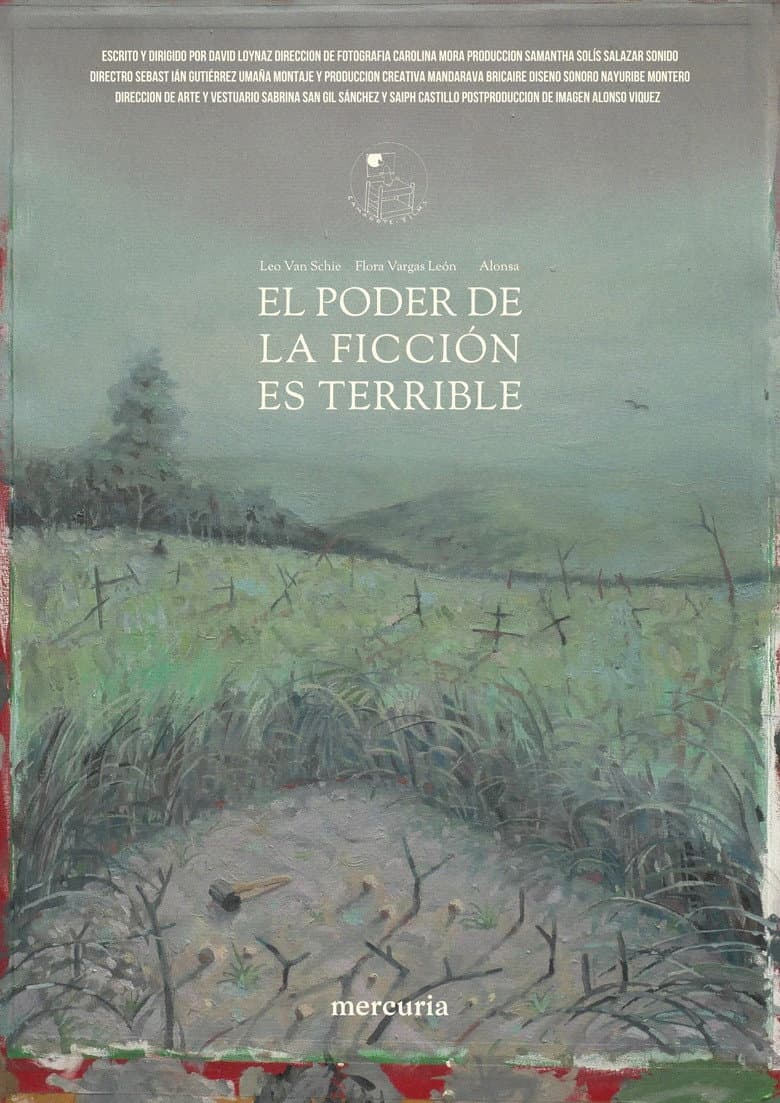
The drizzle of memory, the stubbornness of a dream, and the quiet terror of a story that refuses to stay on the page - David Loynaz’s “The Terrible Power of Fiction” arrives today like a half-remembered ghost. At just 15 minutes, this micro-drama from Costa Rica packs a dense, unsettling meditation on how the stories we tell can colonize not only a landscape, but a marriage. Premiering on July 24, 2026, it’s the kind of short film that feels less like a movie and more like a fever you catch from an old photograph.
Release Date & Where to Watch
Today is your only guaranteed chance to catch “The Terrible Power of Fiction” in its initial theatrical run. The film debuts precisely on July 24, 2026, in select arthouse theaters across Costa Rica, with a single screening at the historic Cine Magaly in San José. Director David Loynaz has confirmed a limited international festival rollout beginning in August, with submissions to the Locarno Film Festival and the New York Film Festival’s short-film sidebar currently pending. For those outside Costa Rica, a streaming release on a curated platform like MUBI or the Criterion Channel is likely by late autumn, but no deal has been publicly signed yet. Given the film’s featherweight runtime, expect it to be bundled with one or two companion shorts for any streaming debut. Theatrical showtimes are sparse, so check local listings or the film’s official site for last-minute additions - this is a piece best seen in darkness, on a proper screen, where the rain can feel almost real.
Cast & Crew
The entire enterprise rests on three performers, each operating in a different register of intensity. Leo Van Schie plays Juan de Cervantes, the Spanish settler who, in the mid-19th century, becomes consumed by a delusion as grand and ridiculous as that of his literary namesake. Van Schie, a Dutch-Costa Rican actor who previously anchored Loynaz’s feature-length experiment “The Drift,” here plays obsession with a taut stillness: his Cervantes doesn’t gesticulate wildly. He speaks of founding a town with the same quiet gravity another man might reserve for reading a weather report. Opposite him stands Flora Vargas León as María Finojosa, the wife who narrates the entire film from inside her own memory. Vargas León is the film’s beating heart and its skeptical eye; her voiceover is the only sound besides rain and the occasional horse’s whinny. She delivers lines like “I loved him most when his madness still had a shape I could hold” with a resignation that borders on the clinical. Alon Campos Perez completes the trio as the spectral “Ángel de la muerte” - Angel of Death - a figure who may or may not be a real person, appearing on the periphery in three brief scenes. Perez brings a disquieting grace to a role that exists almost entirely as a visual echo. Behind the camera, Loynaz directs with a spare hand, aided by cinematographer Andrés Rodríguez, who shot the entire 15 minutes in a single location with natural light bouncing off moss-covered stones.
Story & What to Expect
The plot is deceptively simple. María Finojosa sits alone in a wooden cabin, watching the Costa Rican rain streak the window, and she remembers. Specifically, she recalls the exact moment - a fiery evening in 1854, during a drought that cracked the earth - when her husband, Juan de Cervantes, first announced his intention to found a town. Not just any town, but one bearing his family name: Cervantina. “He spoke as if the land were a blank page,” María’s voiceover tells us, “and his name the only ink he trusted.” But the soil of the Talamanca mountains is stubborn, and the indigenous Bribri people who already live there have no interest in being erased for a Spanish surname. What follows is not an epic of conquest, but a slow, inward collapse. María’s memory, edited to resemble the sprocket-scratched flicker of old film, begins to warp. The rain never stops. A stranger - the Angel of Death, or perhaps just a tired mule driver - appears with news of a failed expedition. Loynaz plays with the porous boundary between fact and fabrication: scenes replay with slight variations, as if María is trying to edit her own history. Is she misremembering her husband’s obsession, or is she finally seeing it clearly? The film’s title is literal: fiction has a terrible power here, one that can dissolve a legacy before it’s even built. Expect no heroism. Expect wet wool, damp silence, and the sound of one woman breathing in the dark while her husband’s dream rots in the mud outside.
Why It’s Worth Watching
At 15 minutes, “The Terrible Power of Fiction” manages something many features can’t: it earns its unease. This is not a comforting historical drama about plucky settlers building something new. It’s a study in how delusion, when spoken aloud, becomes a reality that other people have to pay for. The film’s brevity works in its favor - there is no room for sentiment, no wasted exposition. Loynaz trusts his audience to feel the weight of a town that never was, and the marriage that broke against its blueprint. The performances are quietly devastating, especially Vargas León, whose voiceover gives the film its rueful, almost sorrowful intelligence. “I have the terrible power of fiction,” she says late in the film, watching the rain, as her husband’s image fades like a photograph left too long in the sun. “I can remember him how I need him to be.” That line, translated from the original Spanish script by Loynaz himself, cuts to the heart of the piece: our stories are not benign. They remake the dead, they redraw maps, they justify conquests. In under a quarter of an hour, “The Terrible Power of Fiction” makes you feel the chill of that power, and the loneliness of being the one who inherits its wreckage. See it today, while the rain is still fresh in your mind.