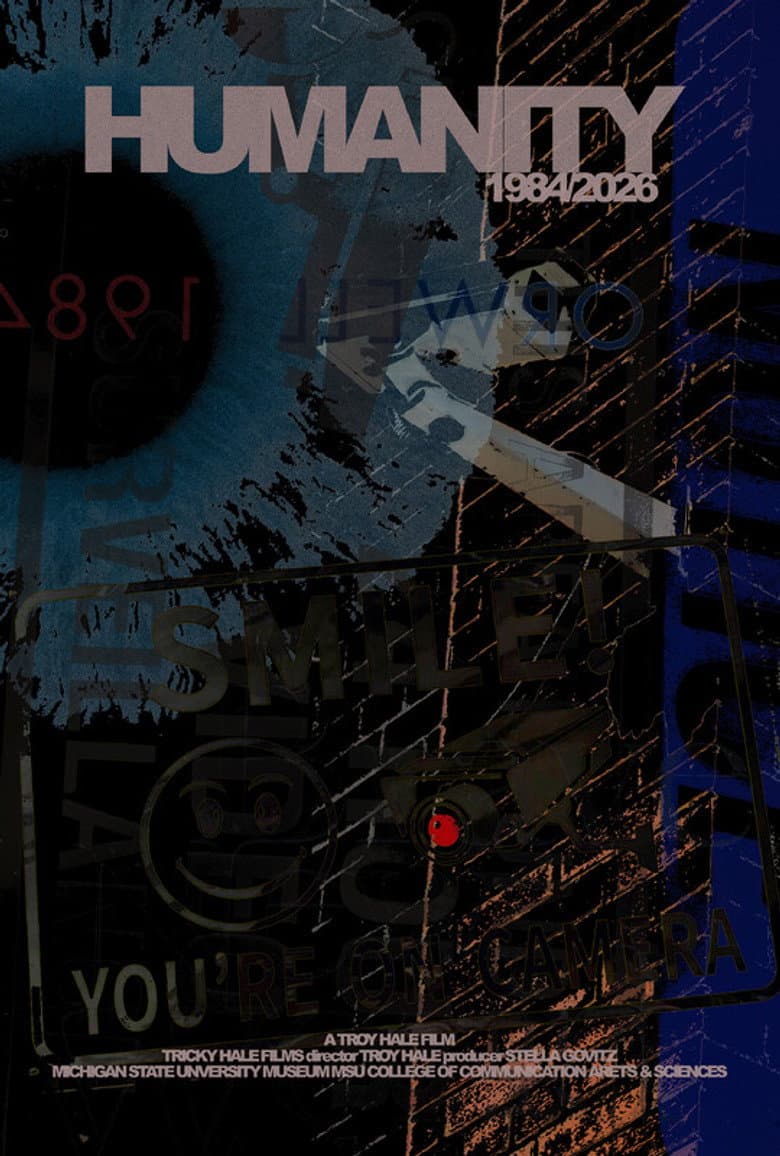
The billionth surveillance camera on Earth was installed in 2021. Do the math and that works out to roughly one lens for every eight human beings alive - a ratio that would have sounded like dystopian science fiction four decades ago, and now reads like a routine infrastructure statistic. That uncomfortable arithmetic sits at the heart of Humanity (1984/2026), a new four-minute documentary short from director Troy Hale that arrives today, September 12, 2026, and asks a question that feels less rhetorical with every passing headline: are we really free?
Release Date & Where to Watch
Humanity (1984/2026) lands on September 12, 2026 - barely a week after the current wave of public anger over FLOCK cameras pushed license-plate surveillance back into the national conversation. The timing is not accidental. With a runtime of just four minutes, the film is built for the short-form, shareable format that dominates the streaming landscape, and it slots into the same documentary corridor as the kind of urgent, ripped-from-the-news nonfiction that platforms have been snapping up all year.
Given its brevity and its subject matter, expect a digital-first rollout - the sort of release designed to be watched on a phone during a lunch break and then forwarded to everyone you know by dinner. Distributors have not confirmed a theatrical component, and honestly, a four-minute film about constant observation doesn't need a red carpet. It needs an audience with a pulse and a reason to look over its shoulder.
Cast & Crew
Troy Hale directs, and that credit carries real weight. Hale has spent his career in documentary and factual storytelling, and Humanity (1984/2026) represents his pivot toward the intersection of technology and civil liberty - terrain that requires a steady hand, because the temptation to preach is enormous and the margin for hysteria is thin.
The cast remains unknown, which is itself a curious creative choice for a film obsessed with the erosion of anonymity. No talking heads have been announced, no celebrity narrator, no familiar voices guiding us through the material. Whether that's a deliberate statement - a documentary that refuses to give surveillance a face - or simply a matter of scale for a four-minute production, the effect is the same. This is a film that wants you to see yourself in the frame, not a movie star. The original language is English, and the production is a Hollywood one, though its concerns reach well past any single border.
Story & What to Expect
Here is the film's central argument, laid out in its own framing: we live in a surveillance state, and we are always being watched. The billionth camera went up five years ago. Stack facial recognition and artificial intelligence on top of that hardware, and the math changes from observation to prediction. Not just where you've been - where you're going to be. The film's premise is that the combination of ubiquitous cameras and machine learning has crossed a threshold, moving us from a world where our movements are recorded to one where they are anticipated.
That's the leap that should keep you up at night, and it's the leap Humanity (1984/2026) appears built to dramatize. Expect archival texture, expect the cold poetry of camera footage, and expect the title's two dates to do heavy lifting. The "1984" reference invokes Orwell, obviously - but look closer and it also suggests a dialogue between two eras. The novel imagined the panopticon. The second date suggests we built it, quietly, one installation at a time, and then handed it predictive powers Orwell never dreamed of.
At four minutes, there is no room for a slow build. This will be a sprint: setup, escalation, confrontation. The film's overview points directly at "the current outrage surrounding FLOCK cameras," which tells us the closing movement lands squarely in the present tense. Whatever remains ambiguous - the genres are officially unclassified - the intent seems clear. This is a provocation dressed as a short.
Why It's Worth Watching
Four minutes is nothing. That's the point. You have spent longer reading this article than the film will take to unnerve you, and that efficiency is precisely what makes it worth your time. A feature-length documentary on surveillance gives you room to build defenses - to intellectualize, to compartmentalize, to check your phone. A four-minute film doesn't offer that luxury. It hits, it ends, and it leaves you sitting with the question.
And the question is genuinely worth sitting with. One camera per eight people. Facial recognition woven into that network. AI stitching the footage into forecasts. These aren't speculative projections; they're described in the film's own materials as present conditions. Humanity (1984/2026) arrives at a moment when public outrage over automated license-plate readers is peaking, which makes it less a piece of entertainment than a piece of punctuation on a conversation already in progress.
Will it change minds? Maybe not. But it might change habits - the way you glance at a pole-mounted box on your commute, the way you think about the word "free." A TMDb rating of 0/10 means nothing here; the film is brand new and largely unrated, so walk in without expectations. Walk in curious instead. At four minutes, that's a bargain. Just don't be surprised if you find yourself looking up at the streetlights on the way home, wondering who else is watching.