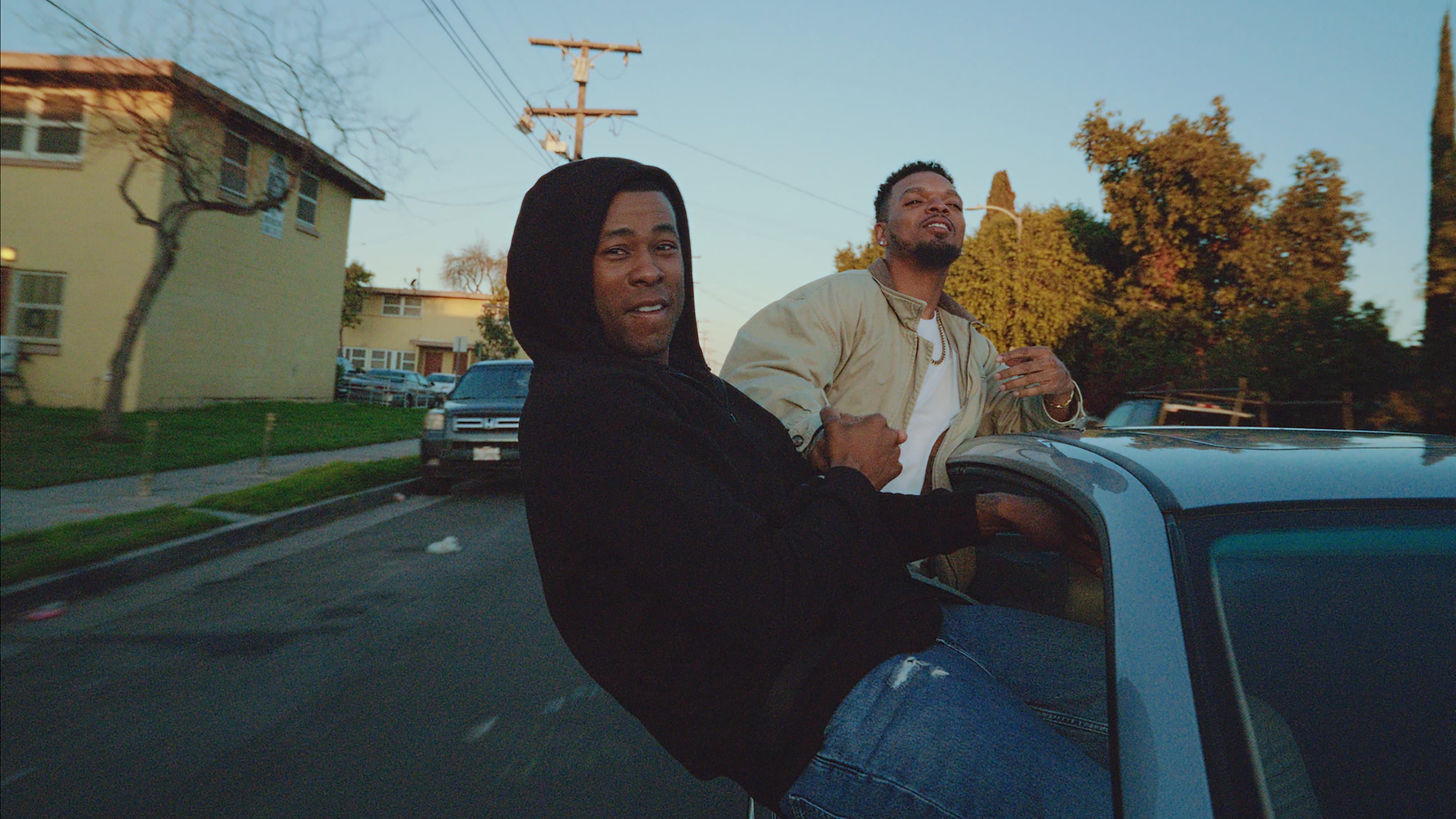
There is a moment in Walter Thompson-Hernández’s debut narrative feature where the city of Los Angeles stops being a backdrop and becomes a character in its own right - a breathing, complicated witness to a boy’s quiet question. That question, which gives the film its title, echoes through every frame of If I Go Will They Miss Me, a poetic and emotionally expansive father-son story that has been quietly building word-of-mouth since its September 11 release.
The film centers on Lil Ant, played with remarkable interiority by Bodhi Dell, a young boy navigating the fragile terrain between childhood imagination and the hard edges of adult reality. His father, Big Ant, is brought to life by J. Alphonse Nicholson in a performance that refuses easy redemption. Big Ant is a man caught between his own wounds and the love he struggles to express. Their relationship is the film’s beating heart - tender, awkward, and painfully real.
Thompson-Hernández, known for his documentary work exploring community and identity, brings a documentarian’s eye to this fictional narrative. The result is a film that feels both intimate and expansive, grounded in specific details yet reaching for something universal. It is a story about Black family, grace, and the hope that love can transform even the most fragile relationships into something more healing and beautiful.
Danielle Brooks delivers a grounded, quietly fierce turn as Lozita, a woman holding together the pieces of a family while tending to her own. The supporting cast - Kelvin Adekunle as the enigmatic 2-Moon Friend, Bre-Z as Jenn, Myles Bullock as JJ, J.J. Boone as Julia Rose, and Zaria Kelley as Acacia - each bring texture to a world that feels lived-in and authentically rendered.
What distinguishes If I Go Will They Miss Me is its refusal to traffic in easy sentiment. The film’s poetic sensibility - evident in its dreamlike pacing and visual metaphors - never obscures the emotional truth at its core. Instead, it deepens it. Thompson-Hernández trusts his audience to sit with ambiguity, to find meaning in silence and gesture. The film’s 89-minute runtime is used with precision; not a scene feels extraneous.
The title itself operates on multiple levels. It is a child’s plea for reassurance, a father’s unspoken fear, and a community’s question about its own worth. In a cultural moment often defined by loud declarations, the film’s quiet interrogation feels radical. It asks what it means to be seen, to be remembered, to matter - particularly for Black boys and men whose lives are too often reduced to statistics or stereotypes.
Cinematographically, the film is a love letter to Los Angeles that refuses the postcard version. This is a city of backyards and boulevards, of golden-hour light filtering through blinds, of spaces where complicated people try to love each other better. The visual language is patient, observant, never showy.
The performances are uniformly strong. Dell, as Lil Ant, carries the film’s emotional weight with a maturity that belies his years. His eyes register every disappointment and every flicker of hope. Nicholson, as Big Ant, resists the temptation to soften his character’s edges; his love is real but imperfect, his presence both a gift and a source of pain. Together, they create a portrait of a relationship that feels achingly human. Brooks, as Lozita, provides a necessary anchor, a reminder that families are often held together by those whose labor goes unacknowledged.
The film’s acclaim - a 7.8 rating on IMDb and a 7 out of 10 on TMDb - suggests that audiences are finding something resonant here. But this is not a film that can be reduced to numbers. It is an experience, a meditation on love and legacy that lingers long after the credits roll.
If I Go Will They Miss Me arrives at a time when conversations about Black fatherhood, mental health, and community care are more urgent than ever. It does not pretend to offer solutions. Instead, it offers something perhaps more valuable: a portrait of people trying, failing, and trying again. It is a film about grace - the grace we extend to others and, crucially, to ourselves.
Thompson-Hernández has crafted a work of remarkable empathy. It does not ask us to judge its characters, only to witness them. In doing so, it reminds us of cinema’s unique power to make us feel less alone. The question at the film’s center - Will they miss me? - hangs in the air. The film’s answer, offered with quiet conviction, is that we already do.